
Ashland City Criminal History Checks
There is no single Ashland City database that joins police narratives, city citations, county bookings, court judgments, and Tennessee histories. Route the request by its purpose. The Ashland City Police records page covers local incident, crash, and citation products. Municipal Court handles tickets issued into that court. Cheatham County offices hold county jail and General Sessions or Circuit records, while the Tennessee Bureau of Investigation maintains the statewide fingerprint-supported history.
- Ask Ashland City Police for the incident, crash, or citation report created by city officers.
- Use the city public-records form for a defined municipal record, and include the record type, date, department, and known number.
- Contact Ashland City Municipal Court if the citation is municipal and confirm the next court date or available record.
- Move to Cheatham County Jail or the Circuit Court Clerk for a booking, General Sessions matter, felony case, or appeal.
- Use TBI TORIS only when a Tennessee name-based criminal-history product is the actual goal.
Use the citation heading and issuing agency as routing clues. A city police report may document an event without any prosecution, and a state history will not reproduce the officer's narrative.
Ashland City's Two Records Counters
Ashland City has two distinct local starting points. The Police Department is at 233 Tennessee Waltz Parkway and keeps reports created by its officers. Municipal Court meets at 405 N. Main Street and handles city citation records. These counters are not interchangeable, even though both concern the same event. A traffic stop can produce a police citation and a later court record, with each office holding a different part.
Ask the police side for an incident narrative, crash product, or police citation copy. Ask the municipal court about the city docket, hearing, costs, fine review, or a court disposition. If the paper names Cheatham General Sessions instead, go to the county clerk at 100 Public Square, Room 225. That simple check keeps an Ashland City records request at city altitude until the document itself points outward.
The official Ashland City Police page identifies the local law-enforcement starting point.
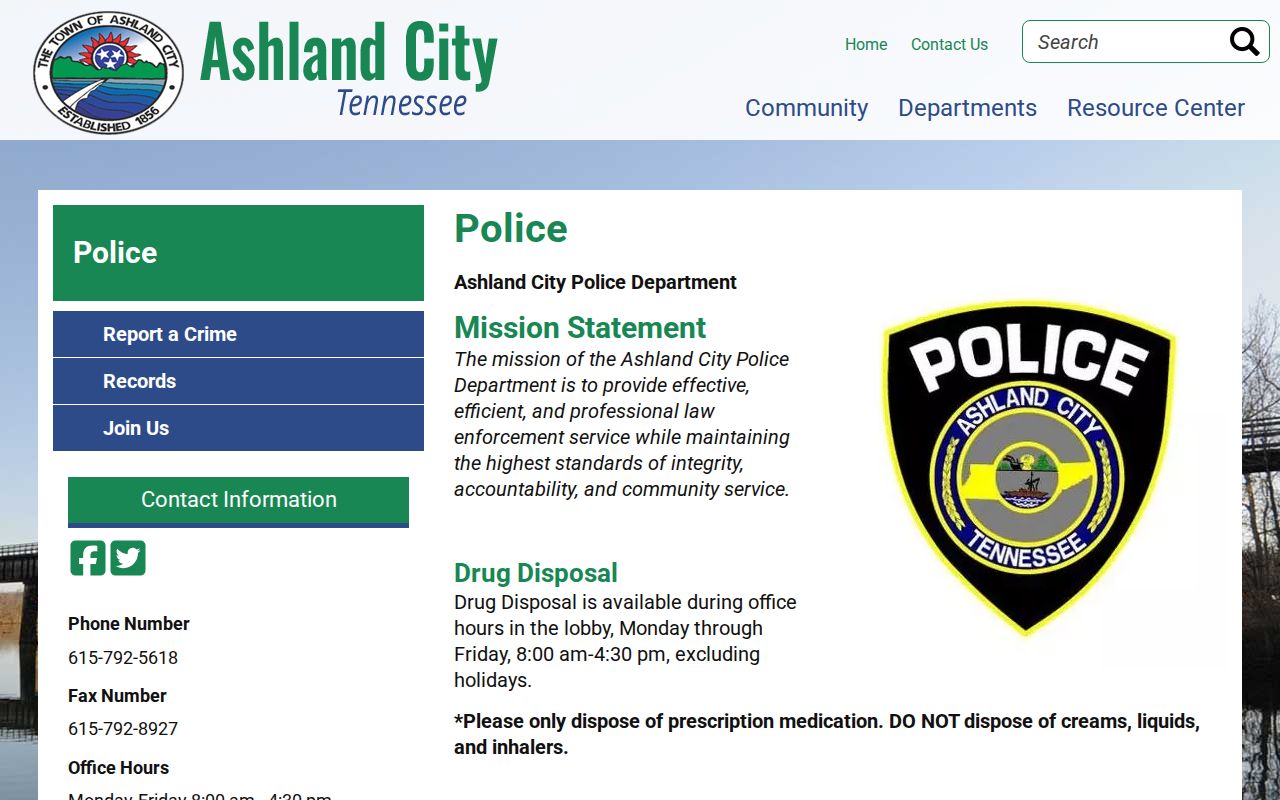
The city department holds its own reports, while county and state offices keep the later layers.
Records at the Ashland City Police Department
Ashland City Police retains incident reports, crash reports, and citations. The department's published rules are more specific than many local records pages. An incident report is generally completed by the end of the officer's shift, but the city tells requesters to allow 72 hours when call volume is heavy. That period is an operating allowance, not a promise that all investigative content will be public.
Crash records follow a separate track. A crash that must be reported to the state goes through command and state approval, and Ashland City says to allow five to seven business days. A crash that does not meet the state-report threshold receives an operations report. Name the correct product when requesting it. Police also publishes copy charges of $0.15 per black-and-white page and $1 per picture. Confirm the total before ordering a large file.
| Ashland City record | Published timing | Published copy rule |
|---|---|---|
| Incident report | Usually complete by end of shift; allow 72 hours under heavy volume | $0.15 per black-and-white page |
| State-reportable crash | Allow 5 to 7 business days for command and state approval | Confirm page and any image total |
| Other crash | Ask when the operations report is ready | $0.15 per black-and-white page |
| Picture | Depends on the related record | $1 each |
Ashland City Incident Record Timing
The 72-hour guidance helps a reader avoid arriving before the report is complete. It does not mean Ashland City always waits three days. The normal benchmark is the end of the officer's shift, with more time allowed under heavy volume. A request made too soon may yield no copy even though the event has already occurred. Give the records staff the date, place, report number, and record type if known.
A completed police report can still contain material that is not open for release. An active criminal investigation, protected victim data, juvenile information, and confidential identifiers may be withheld or redacted under Tennessee rules. Ask whether a public portion can be separated if the full Ashland City report cannot be released. A redaction is not the same as the absence of a record.
Note: Count the published 72 hours as an allowance during heavy volume, not a guaranteed delivery deadline.
Booking and Arrest Records in Ashland City
Ashland City Police creates the arrest report when its officer makes the arrest. Booking then occurs through Cheatham County Jail at 264 South Main Street. No official public county jail roster was found in the research, so recent custody questions should go to the jail at (615) 792-2042. The police narrative and jail intake remain separate records, even when both stem from one Ashland City arrest.
The original booking charge is not a final conviction. A prosecutor may file a different count, a court may dismiss or reduce it, or the case may end without guilt. General Sessions handles early and lower-level county criminal matters. A felony can move to Circuit Court after bind-over and grand-jury action. Readers who need the full county path can use the Cheatham County arrest search for each official channel without treating the city report as the final case outcome.
Ashland City Ticket or County Record
The citation itself usually answers the first routing question. Ashland City explicitly directs municipal citations to its Municipal Court and General Sessions citations to the Cheatham County clerk. A ticket issued inside the city is not automatically a city court matter. Read the court name, case or citation number, appearance information, and issuing agency before calling.
| Paper or event | First Ashland City route | When it leaves the city |
|---|---|---|
| City incident report | Ashland City Police | County court only if charges enter that system |
| Municipal citation | Ashland City Municipal Court | Circuit Court on an applicable appeal |
| General Sessions citation | Cheatham County Circuit Court Clerk | Already a county court record |
| Custodial arrest | Police report, then Cheatham County Jail | General Sessions and possibly Circuit |
This division prevents a common error: asking Municipal Court for a General Sessions file because the stop occurred in Ashland City.
The Ashland City Municipal Court File
Ashland City Municipal Court meets at 405 N. Main Street. Judge William Patrick Smith and clerk Cynthia Hollingsworth are identified on the official page. Traffic court is scheduled for the first Thursday of each month at 9 a.m. and 1 p.m., with review of costs and fines at 10 a.m., subject to holidays and conflicts. Confirm the date before relying on the recurring schedule.
| Court name | Ashland City Municipal Court |
|---|---|
| Local record scope | Municipal and traffic citations assigned to the city court. |
| Case lookup channel | Contact the court; the official page does not advertise a public case-search portal. |
| Useful record facts | Citation or case number, hearing date, charge or ordinance, court action, costs, and fine status where public. |
| Payment types | Cash, money order, or credit card; no personal checks. |
| Traffic school | $50 monthly Thursday session from 5 to 9 p.m.; bilingual option available by phone at (615) 792-5719. |
The official court view shows the Ashland City source for schedules and payment rules.
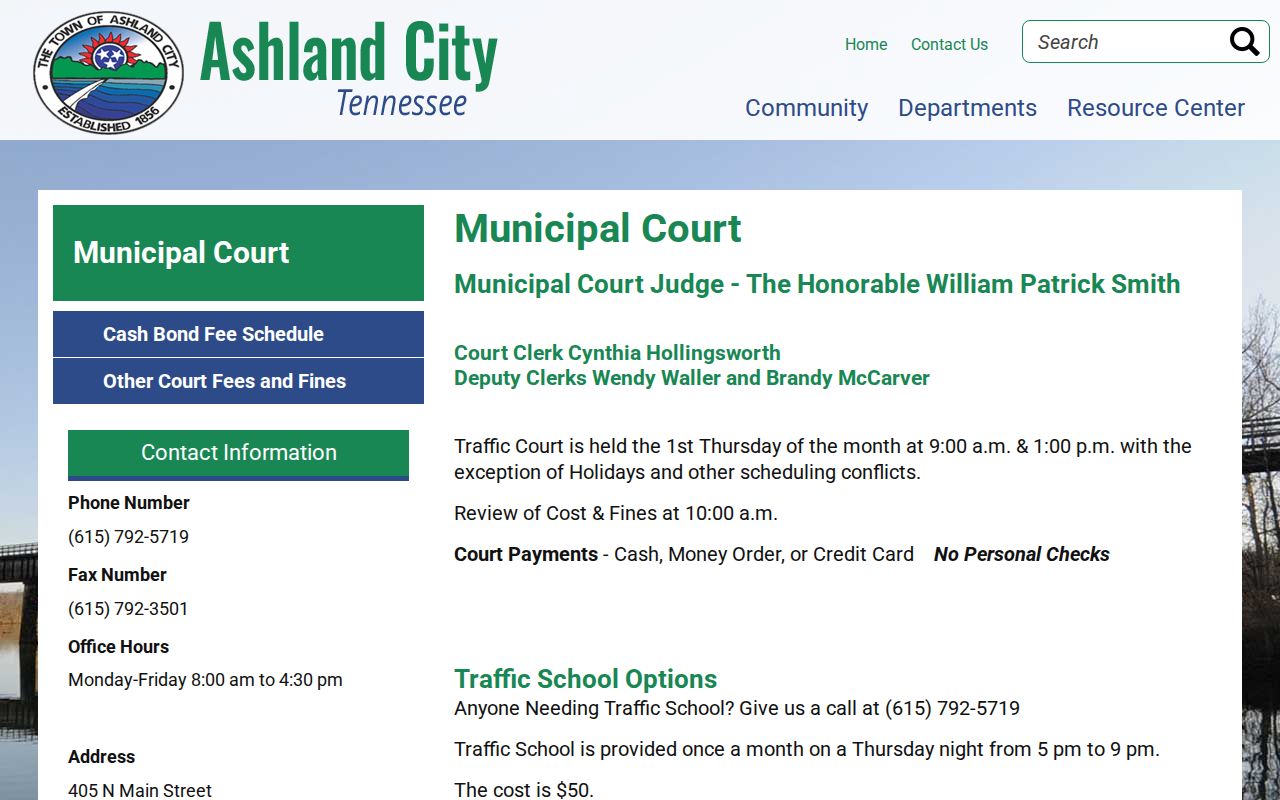
That municipal channel should be used only when the citation names the city court.
Ashland City Signed Record Request
The Ashland City public-records request channel requires more than an informal email. Type the form, print it, sign it, and email it with a copy of a Tennessee state ID or driver's license to publicrecords@ashlandcitytn.gov. The city identifies Recorder Mary Molepske as the contact at (615) 792-4221, extension 5221.
Describe the record with care. Include requester and contact details, the record type, date, responsible department, preferred delivery method, and a known incident or citation number. The form also calls for a signature and date. Those facts help Ashland City distinguish a police incident from a municipal court record and narrow the search. Ask for an estimate if copies, pictures, certification, redaction, or staff time may produce a cost.
The official form page illustrates the city's signed-request and identification requirements.
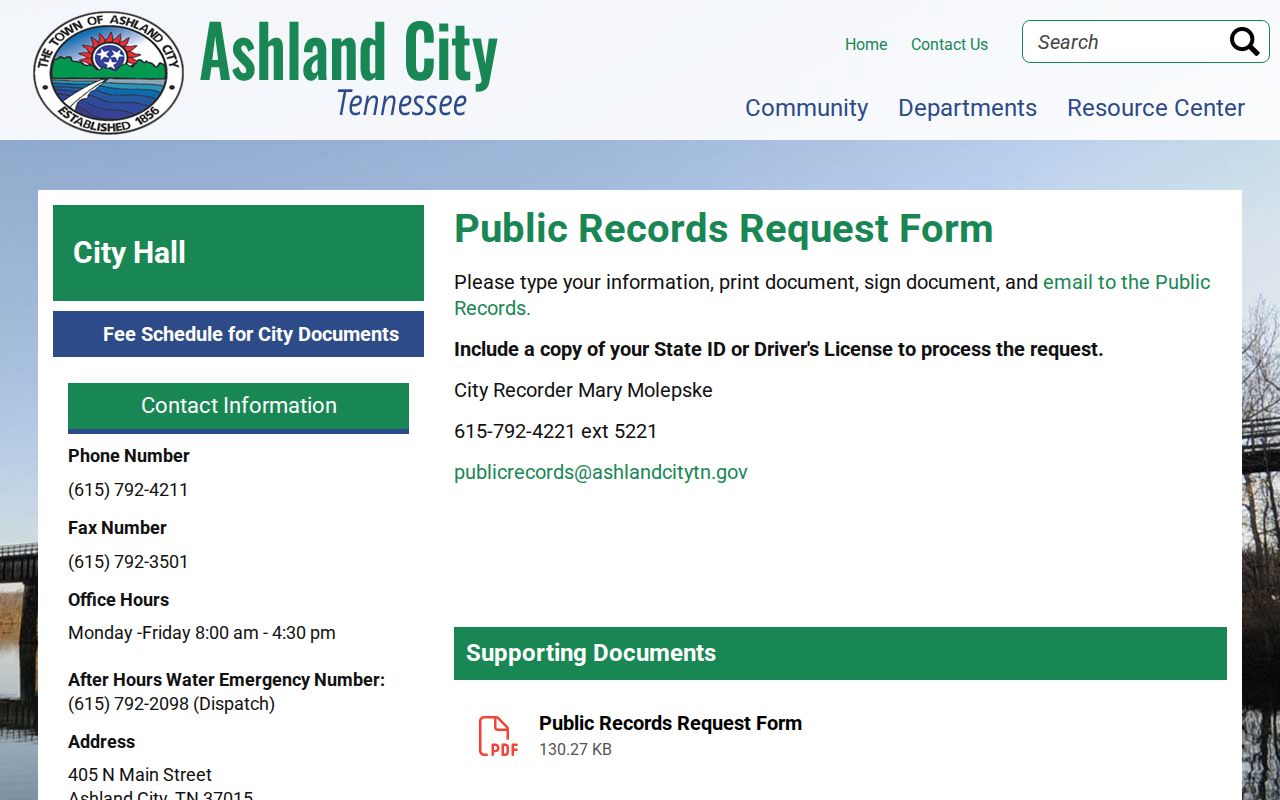
Following that process gives the recorder enough proof and detail to route the Ashland City request.
How Ashland City Records Reach the County
An Ashland City event can produce several records over time. Police create the report and citation or arrest paperwork. A custodial arrest creates a Cheatham County booking. Municipal citations stay at city court unless an appeal takes them to Circuit Court. County charges start or pass through General Sessions, and felony prosecutions proceed in Circuit. Reported fingerprints and final dispositions can then reach the Tennessee Bureau of Investigation.
Record flow: Ashland City Police › Cheatham County Courts › Tennessee Bureau of Investigation
That line is a route, not a claim that every Ashland City incident reaches every stop. A report with no arrest may stay with police. A municipal ticket may never become a state criminal-history entry. TORIS is built from misdemeanor and felony arrests supported by fingerprint submissions, so it can miss an event that never meets that path. The originating office remains the best source for its own record.
Ashland City Crash Record Types
Ashland City distinguishes a state-reportable crash from one documented with an operations report. The first goes through command and state approval, which explains the published five-to-seven-business-day wait. The second is still an official city product, but it is not the same form. Requesting only a “crash report” may slow the search if staff must first determine which kind exists.
- State-reportable crash report
- A crash product that goes through command and state approval before release.
- Operations report
- The Ashland City record used when a crash does not require a state report.
- Incident report
- The officer's record of an event, generally complete by shift end but subject to the city's 72-hour allowance during heavy volume.
- Citation
- The charging or traffic paper whose named court determines whether the next record is municipal or county.
Give the event date, exact location, parties known to the requester, and any report number. Ask which product the department holds before paying for copies.
Ashland City Traffic Court Schedule
Municipal traffic matters run on a local calendar. Ashland City publishes first-Thursday sessions at 9 a.m. and 1 p.m., with cost and fine reviews at 10 a.m. Holidays and conflicts can change that pattern. A person should confirm the date attached to the citation rather than treating the general schedule as a summons.
Traffic school is a separate named city program. The published session is a monthly Thursday from 5 to 9 p.m., costs $50, and has a bilingual option available by phone. Eligibility and case effect should be confirmed with Municipal Court. The court accepts cash, money order, or credit card and states that personal checks are not accepted. Those details belong to the city court record, not a county booking or TBI history.
Note: A traffic-school payment or class date should be confirmed with the court before attendance.
Ashland City Record Access Rules
Tennessee's public-records framework applies to Ashland City executive-branch records, while court access also rests on judicial rules and law. A custodian should provide prompt access when practical. If prompt production is not practical, the Tennessee Public Records Act sets a seven-business-day response framework: the custodian may provide the record, deny it in writing with the legal basis, or give a written estimate for production. It is not a promise that every record will arrive within seven days.
Key Statutes:
Tennessee Public Records Act, Tenn. Code Ann. §10-7-503 gives Tennessee citizens the general inspection right and the response framework when prompt access is impractical.
Tenn. Code Ann. §10-7-504 protects confidential records and information that falls within a legal exception.
Tenn. Code Ann. §10-7-505 provides a route for judicial review of a public-records denial.
Open status does not make every part public. Ashland City may redact protected identifiers, victim data, juvenile material, or other confidential facts. Pending investigative material can also be restricted. Ask for segregable public portions and a written legal basis if access is denied. For general help with the Tennessee law, the Office of Open Records Counsel provides guidance and resources.