
Criminal Court Cases in Cheatham County
Cheatham County criminal court cases can pass through more than one court. General Sessions receives warrants, citations, preliminary hearings, and lower-level criminal matters. A felony may begin there before a grand jury acts or the case is bound over to Circuit Court. Circuit Court then handles the felony prosecution. It also hears appeals from General Sessions, Juvenile, and Municipal Courts. The court name on the citation or charging paper is the best first clue because separate stages can carry separate docket numbers.
The elected Cheatham County Circuit Court Clerk serves Circuit, General Sessions, and Juvenile Courts. Municipal courts keep their own city citation dockets before any appeal reaches Circuit Court. A person seeking a Cheatham County criminal case file should not ask a police records counter for the judgment. Police keep the incident or arrest report, while the clerk keeps the filed charge, hearings, pleas, orders, disposition, and sentence.
No Cheatham Trial-Court Portal
Tennessee does not provide one public search for county trial cases, and the Cheatham clerk does not advertise a free document portal. That is an access fact, not proof that the file is closed. The reliable route is to identify the correct court, then contact the clerk with a docket number or a precise name and year. Ask whether the record is in General Sessions or Circuit, whether it remains on site, and which parts may be inspected.
Online searches can also create false confidence. A statewide criminal-history result is not the clerk's docket, and an appellate result does not cover ordinary trial proceedings. Older files, certified judgments, charging papers, and complete count-by-count outcomes may require a counter, phone, or mail request. Cheatham County has not published a stable criminal-case copy or certification fee in the reviewed sources. Request the current price and delivery options before sending payment.
Note: No public trial portal means the Cheatham County clerk, not a broad web search, is the key source for local case status.
Cheatham County Case Record Searches
Use the local clerk first for Cheatham County criminal court cases and reserve the state system for an appeal. The paper citation, warrant, bond sheet, or prior court notice may identify the division and docket. Name spelling, an approximate filing year, and the charge help when the number is unknown. Ask for each count, since one count may be dismissed while another ends in a plea or conviction.
- Read the citation or warrant to determine whether the matter belongs to a municipal court, General Sessions, or Circuit Court.
- Call the Cheatham clerk with the docket number, exact name spelling, approximate year, and charge.
- Ask about inspection, public documents, archived files, delivery methods, and current copy or certification charges.
- Review every count, docket event, and disposition rather than relying on the original charge alone.
- Request the charging document and signed judgment or order when proof of the outcome is needed. Use C-Track only for an appeal.
This sequence also helps with an incomplete Tennessee Bureau of Investigation record. If a TBI history lacks the final result, obtain a certified Cheatham County judgment first. The court and repository are distinct custodians, so correcting the clerk file does not by itself prove that the state record has updated.
Cheatham Court Clerk in Room 225
The criminal-record counter is at the Cheatham County Courthouse, 100 Public Square, Room 225, Ashland City, TN 37015. Call (615) 792-3272 or fax (615) 792-3203. The clerk's role spans docket control, record custody, court administration, financial entries, jury work, and public communications. That broad role makes the office the best routing point when a searcher knows a Cheatham County case exists but cannot tell whether it stayed in General Sessions or moved to Circuit.
Cheatham County Circuit Court Clerk
100 Public Square, Room 225
Ashland City, TN 37015
(615) 792-3272
Fax: (615) 792-3203
Bring or state the docket number when possible. If not, narrow the request with a full name, approximate year, charge, and court division. Ask whether inspection is available before ordering copies, whether a document can be certified, and whether sealed or redacted material affects what can be released. No dedicated records kiosk or courthouse device policy was confirmed, so call before relying on equipment access.
What a Criminal Case File Contains
A Cheatham County criminal case file records the prosecution rather than just the arrest. The header links the docket to a court, filing date, status, and judge. The charging paper sets out allegations, while later entries reveal how prosecutors and the court treated each count. A judgment or signed order is usually more useful for proving an outcome than a calendar line or booking entry.
| Case Number & Court | Identifies the docket and whether General Sessions, Circuit, or a municipal court holds that stage. |
|---|---|
| Charging Document | Shows the warrant, indictment, presentment, information, citation, or lower-court appeal that opened the matter. |
| Docket Entries | Tracks appearances, motions, preliminary hearing, bind-over, arraignment, plea, trial, and later filings. |
| Offense Counts | Lists original and final Tennessee code sections, offense descriptions, misdemeanor or felony status, and class. |
| Disposition & Judgment | Records acquittal, conviction, dismissal, plea, diversion, transfer, or another count-specific result. |
| Sentence & Conditions | May state custody, probation, fines, costs, restitution, and later violation action. |
Protected identifiers do not become public merely because an official reporting form collects them. Social Security numbers, confidential juvenile material, sealed filings, and protected victim information may be withheld or redacted. Financial entries may appear in the clerk system, but no complete public online field set is available for Cheatham County trial cases.
Cheatham Appeals Reach C-Track
The Tennessee Public Case History system, also called C-Track, covers the Supreme Court, Court of Appeals, and Court of Criminal Appeals. It does not replace the Cheatham County trial file. Use it when the local criminal court case was appealed. Searchers can use a case number, case style, party name, or business or organization name as the search key.
| Field Label | Type | Required | Notes |
|---|---|---|---|
| Case number | Text | One search key | Sequence digits may locate the full appellate number. |
| Case style | Text | One search key | Use words from the State and party caption. |
| Party name | Text | One search key | Search by a party to locate the appeal. |
| Business/organization | Text | One search key | Applies when an organization is a party. |
| Search | Button | Yes | Returns matching appellate cases. |
The case detail may show status, the originating Cheatham County court, events, motions, orders, judgments, and opinions. Many documents filed after August 26, 2013 are linked as PDFs, while some older migrated orders are also available. A missing local arraignment or trial filing should still be requested from Room 225.
The manifest view comes from the official appellate case-history source.
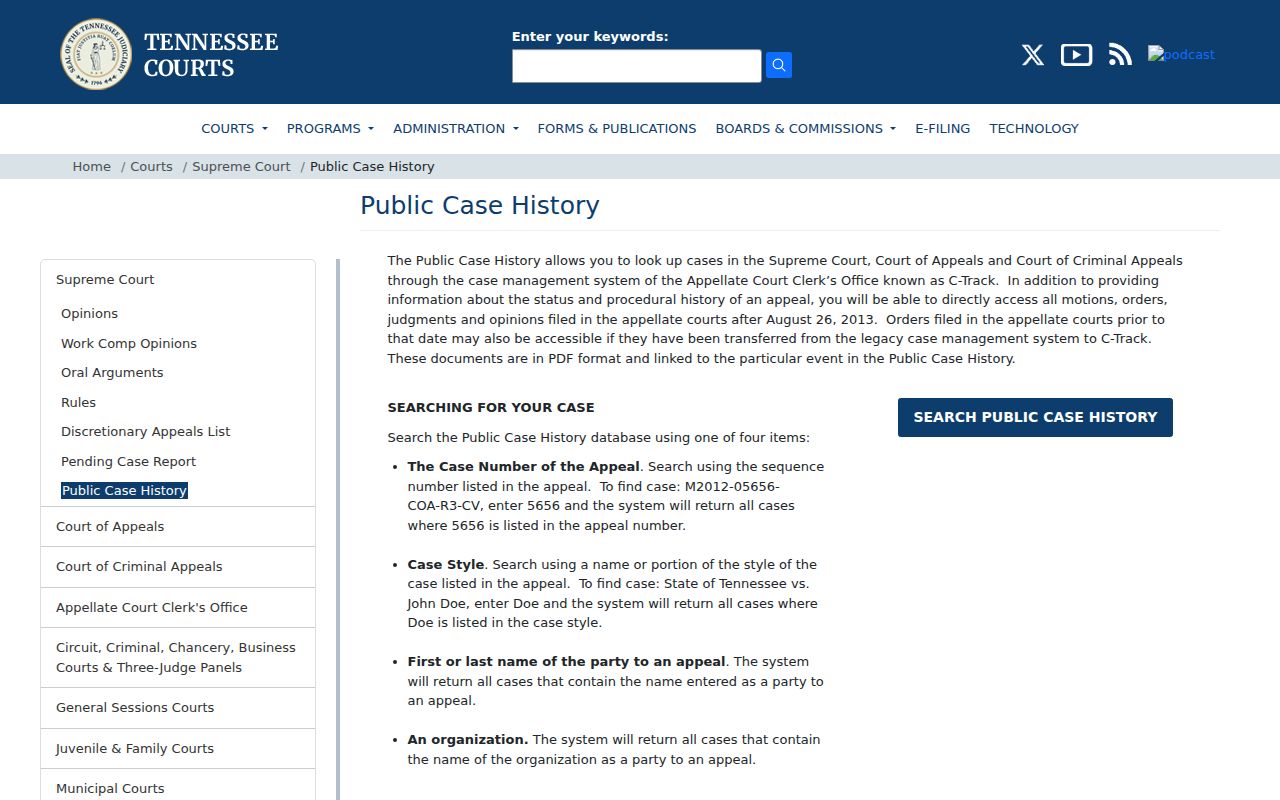
It illustrates the state appellate layer that becomes relevant only after a Cheatham County case leaves the trial court.
Criminal Case Stages in Cheatham County
A Cheatham County felony often starts with a warrant or arrest and an initial General Sessions record. Preliminary proceedings determine whether it remains at that level or moves forward. Grand-jury action can produce an indictment or presentment, after which Circuit Court handles arraignment, motions, plea negotiations, trial, disposition, and sentence. Lower-level cases may conclude in General Sessions. Municipal citation cases begin in their city court and can reach Circuit on appeal.
Case flow: Charges Filed › Arraignment › Pretrial › Plea or Trial › Disposition › Sentencing
The path is not always linear. Counts can be amended, dismissed, transferred, or resolved through diversion. A probation violation or post-conviction filing may reopen activity under the same case or create a related docket. No fixed Cheatham County timing was established for each stage, so hearing dates and current status should come from the clerk.
Note: The original arrest charge may differ from the final charge after prosecutor review, grand-jury action, plea, or trial.
Cheatham Dispositions in Plain Terms
Tennessee's judicial reporting form uses specific disposition codes. An acquittal means the fact finder returned a not-guilty result. A conviction means guilt was entered after plea or adjudication. Dismissal or nolle prosequi means the charge ended without conviction; “nolle prosequi” is a prosecutor's decision not to proceed with that charge. A guilty plea may be recorded as charged or to a lesser offense.
- Diversion
- A court-supervised route that may lead to dismissal and possible expungement after successful completion.
- Transfer or remand
- The matter moves to another court or returns to a lower court for more action.
- Retired or unapprehended
- The case is not shown as a final conviction and may require clerk review to learn its present posture.
- Disposition date
- The date the stated result was entered for that count, not necessarily the arrest date.
Read each count separately. A single Cheatham County docket can contain more than one result. If the TBI history has a blank disposition, do not treat that blank as proof the charge remains pending or ended in guilt. Obtain the certified order or judgment from the clerk, then use the official repository challenge process if the state history is wrong.
Access Rules for Case Records
Open Cheatham County court files can still contain restricted parts. Juvenile records are generally protected. Sealed indictments, protected victim information, confidential identifiers, and some investigative material may also be withheld. A redaction removes protected content while allowing release of the rest. Ask whether nonexempt portions can be separated when a document contains both public and confidential information.
The Tennessee Office of Open Records Counsel explains the Tennessee Public Records Act, including the response framework in Tenn. Code Ann. §10-7-503. When prompt access is not practical, the custodian generally has seven business days to provide access, issue a written denial with its legal basis, or give a written production estimate. That rule is not a guarantee that every requested case file arrives within seven days. Court records also follow judicial access rules.
Expungement begins in the court where the case arose. Eligibility turns on the precise charge and result. Tennessee authorities state that eligible dismissed, nolle prosequi, no-true-bill, not-guilty, or arrest-without-charge outcomes may qualify under Tenn. Code Ann. §40-32-101. Keep a certified signed order because the clerk, arresting agency, TBI, TDOC, and FBI process separate downstream changes.
Federal Cases Outside Cheatham Courts
A federal prosecution tied to Cheatham County is not filed in Circuit Court. Cheatham lies in the Middle District of Tennessee, so the federal docket is maintained by the U.S. District Court and accessed through PACER. PACER requires registration and may show the case number, parties, judge, indictment, docket events, and orders, subject to federal sealing and redaction rules.
The federal portal charges $0.10 per page, usually capped at $3 per document, and current judiciary policy waives a quarter's bill when charges total $30 or less. Some opinions are free. Those federal terms do not set Cheatham County clerk fees. The two systems have different custodians, case numbers, and access rules.
The assigned image was captured from the official PACER access site.
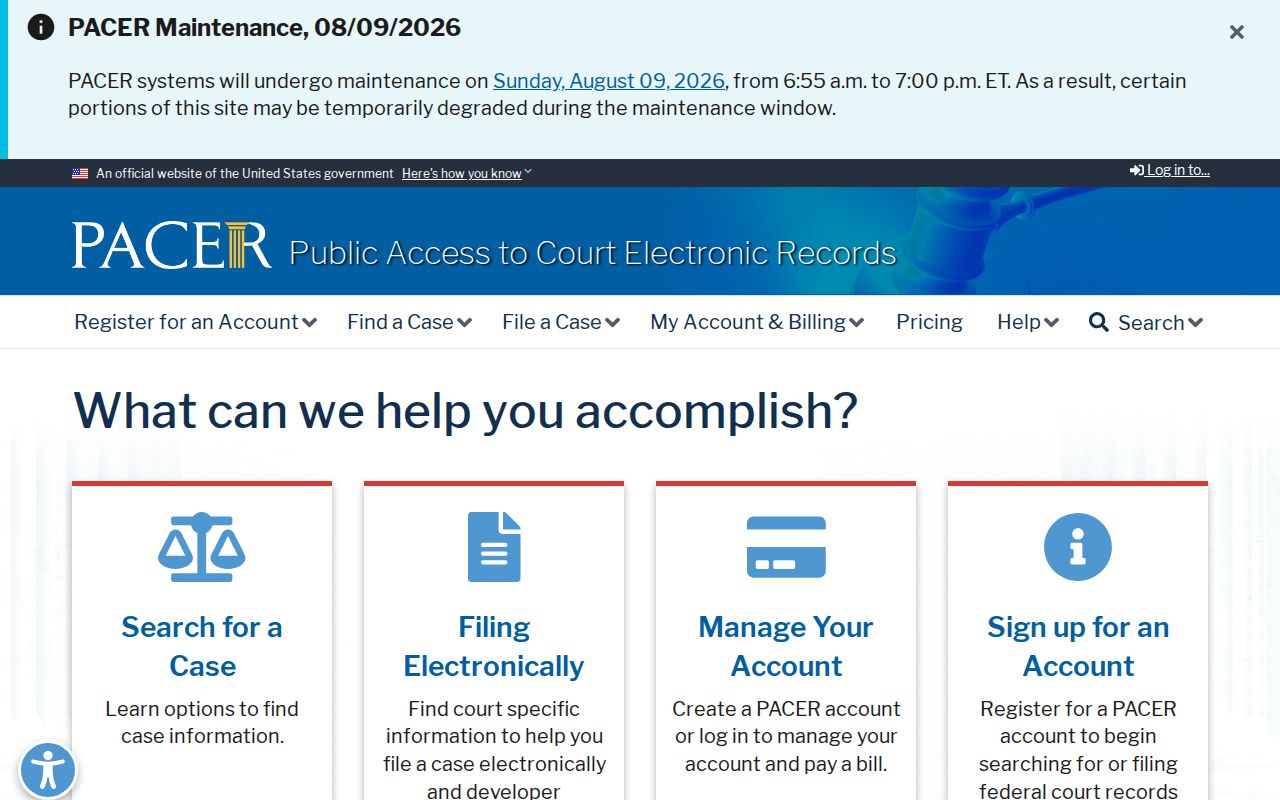
It marks the point where a federal record search leaves Cheatham County's courthouse and moves to the federal judiciary.